
QUANTIFIED VALUE
Manual flow adjustment vs. active closed-loop gas control: how to achieve welding gas saving
SUXIN Academy · ~4 min read
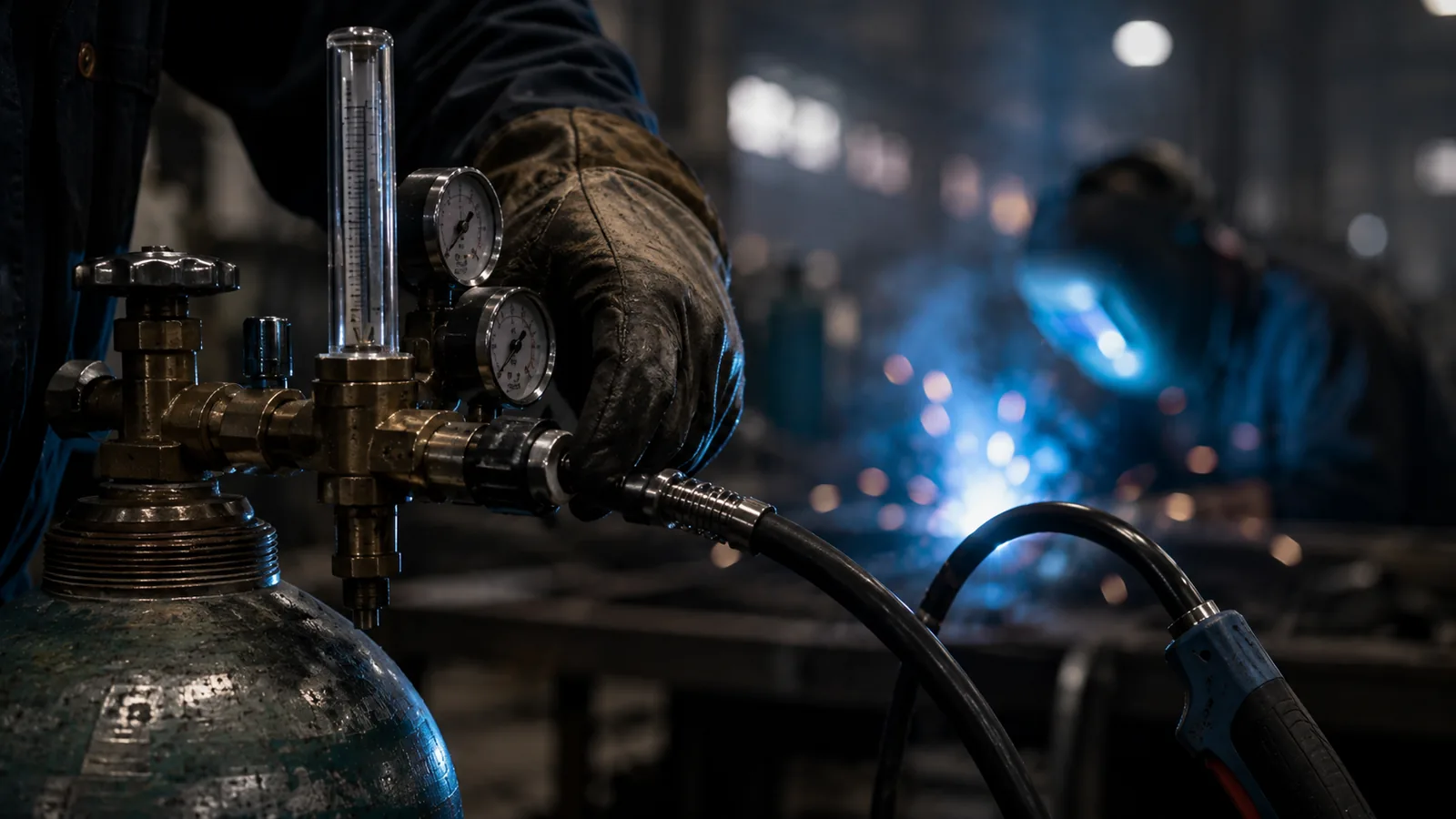
Given that about a quarter of shielding gas is wasted, the next question is: what method reclaims it. There are three common paths — turning the flow down manually, monitoring without control, and active closed-loop supply on demand — and they differ widely in effect and in where they apply, so the wrong choice means twice the effort for half the result.
The most direct is to turn the flow down manually, or to swap in a so-called gas-saving valve. This works to a degree, but the limits are clear: set the flow too low and protection may be insufficient, causing porosity; set it too high and you are back to waste. It is also a fixed value, unable to respond to transient waste such as arc-start overshoot and end-of-weld spill.
Another approach is “monitoring without control” — recording gas flow with an instrument, which helps surface problems but cannot intervene in real time during welding. It can show that waste exists, but it cannot stop the waste from happening.
Active closed-loop gas control is different: high-precision sensing reads welding current in real time and supplies gas dynamically according to the actual needs of the welding process — no overshoot at arc start, no drift during arc-on, an immediate stop at arc-off, and an alert on leaks. It targets the very moment waste is created, rather than adjusting or recording after the fact. The essential difference between the three is “passive pressure holding, passive recording” versus “active, on demand.”
For lines that seek stable gas saving without sacrificing weld quality, active closed loop is the sounder option: it neither relies on repeated trial-and-error by hand nor risks protection for the sake of saving gas. Such a welding gas-saving device has a low cost and typically pays back in half a year to a year.
Suxin has worked for years on smart welding and welding gas saving, holds 70+ invention patents, and has proven active closed-loop gas control on leading lines such as BMW and Honda. To find out how much more you can save relative to manual adjustment, estimate it with the gas-saving calculator.
Continue reading · Quantified Value
← Back to「Quantified Value」