
QUANTIFIED VALUE
The four sources of shielding-gas waste
SUXIN Academy · ~4 min read
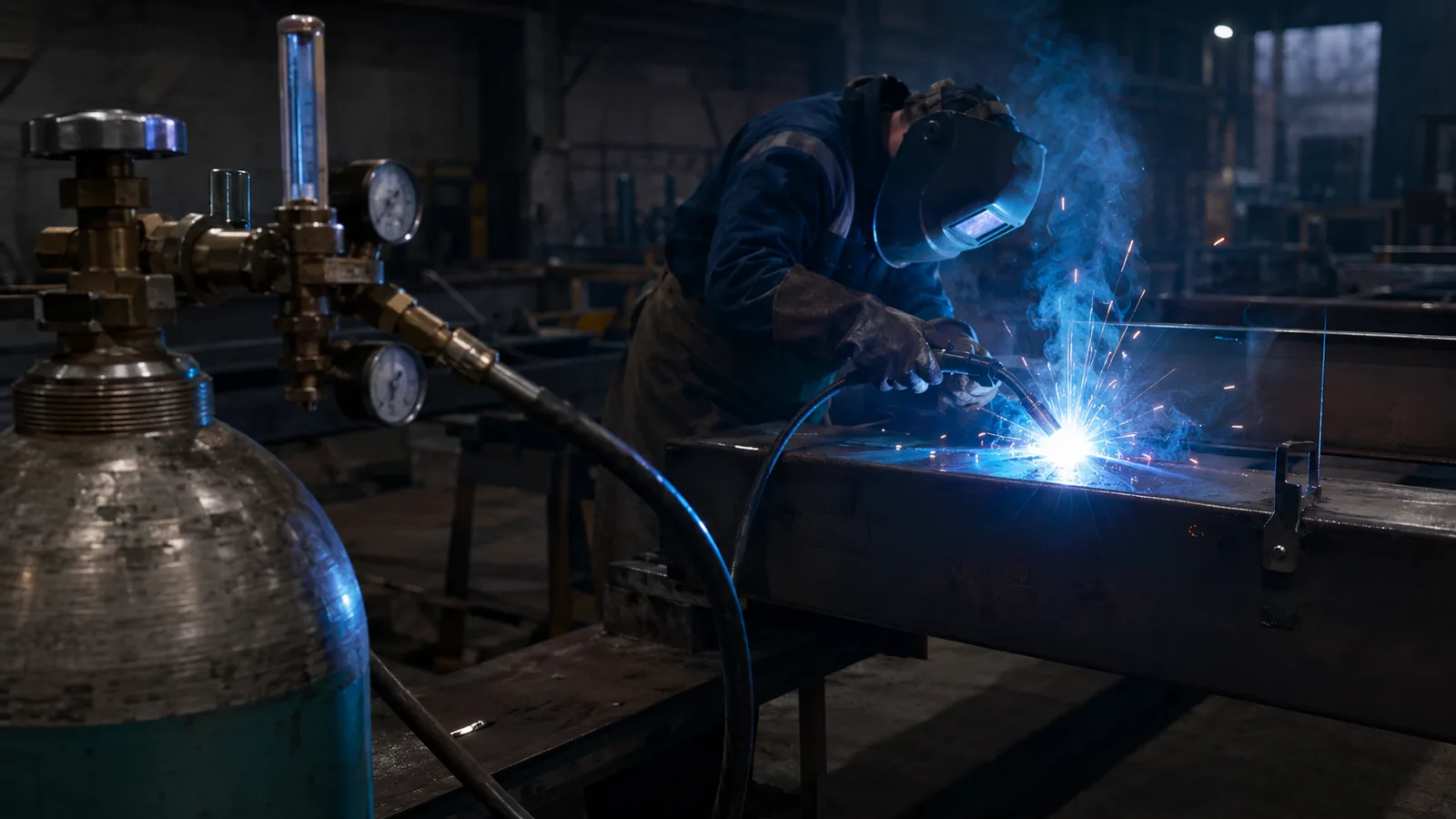
Most plants carefully account for wire and power, yet rarely account for shielding gas. On a typical MIG/TIG line, about a quarter of the shielding gas is not used for welding — it flows away as ineffective supply. It appears on no work sheet, yet it steadily inflates welding cost.
This waste persists because it is spread across four separate environments that are hard to see with the naked eye, and any single measure can only cover one of them: experience alone can neither detect nor root out each one.
The four sources each have their own mechanism. First, metering & flow mismatch (≈10% and 5%): flow is usually set by experience, tends to run high, and no longer matches once the process changes. Second, arc-start overshoot (≈5%): the surge of gas at the instant the solenoid valve opens far exceeds what is needed to stabilize. Third, end-of-weld spill (≈3%): after the arc stops, the valve closes with a lag and shielding gas keeps escaping. Fourth, line leaks (≈2%): the continuous minor leakage at fittings and hoses, which draws gas even at standby.
What the four kinds of waste share is that they all occur “outside welding” — they do not affect weld quality and are pure ineffective consumption. A traditional mechanical regulator holds pressure passively, is blind to the welding process, and cannot respond to transients such as arc start and arc stop, so the waste is hard to eliminate one by one. Whether it is worth addressing depends on scale: multiply the waste ratio by annual gas volume, and that is the cost flowing away for nothing each year.
To truly eliminate these four kinds of waste, simply turning the flow down — or even swapping in a gas-saving valve — is not enough. The key is to make the supply track the welding process in real time: high-precision sensing reads the arc-start, arc-on and arc-off states, and the controller then runs an active closed loop, supplying gas on demand — suppressing arc-start overshoot, stabilizing flow, stopping at arc-off, and flagging leaks in time. What is recovered this way is wasted gas, not the gas the weld needs; and because the hardware cost of such a welding gas-saving device is low, it typically pays back in half a year to a year, after which the annual savings are pure net gain.
Suxin has long focused on smart welding, with years of work on welding gas saving, 70+ invention patents, and deployments proven on leading lines such as BMW and Honda. To systematically bring these four kinds of waste under control, start by estimating your line’s annual savings potential with the gas-saving calculator.